Modern architecture is no longer limited to glass towers and conventional concrete structures. Around the world, architects and engineers are experimenting with unusual forms, advanced structural systems, sustainable materials, digital design, and stronger connections between buildings and their surroundings.
Some of the world’s most innovative modern buildings demonstrate how architecture can respond to climate, technology, culture, urban density, and environmental challenges. Their importance comes not only from their appearance but also from the ideas and engineering behind them.
From the fluid form of the Heydar Aliyev Center in Azerbaijan to the plant-filled Bosco Verticale in Milan and the futuristic Museum of the Future in Dubai, these projects show the different directions contemporary architecture can take.
Note: There is no single official ranking of the “world’s most innovative modern buildings.” The examples below are selected because of documented innovations in architectural form, structure, materials, sustainability, or relationship with the surrounding environment.
1. Heydar Aliyev Center — Baku, Azerbaijan
Designed by Zaha Hadid Architects, the Heydar Aliyev Center is one of the best-known examples of fluid contemporary architecture.
Completed in 2013, the cultural center uses sweeping curves and continuous surfaces to create a strong relationship between the building, its plaza, and its interior spaces. The design deliberately moves away from rigid rectangular forms, creating an architecture that appears to rise from the surrounding landscape.
One of the project’s technical challenges was turning its complex geometry into a buildable structure. The building combines a concrete structure with a space-frame system, while GFRC and GFRP were used for different parts of the exterior envelope.
Why it is innovative
- Fluid architecture replaces conventional box-like geometry.
- The plaza and building are visually integrated.
- Digital design helped manage the complex geometry.
- Structural and façade systems were coordinated to achieve the continuous form.
The project demonstrates how parametric and computational architecture can translate highly complex forms into physical buildings.
2. CCTV Headquarters — Beijing, China
The CCTV Headquarters in Beijing, designed by OMA, challenges the conventional idea of a skyscraper.
Instead of creating a traditional vertical tower, the building consists of two towers that lean toward each other and connect through a large cantilever. The completed form creates a continuous loop that accommodates different parts of television production.
Its structural system is particularly important. A visible diagonal steel framework forms part of the building’s external structure, with denser areas corresponding to regions experiencing greater structural stress.
Why it is innovative
The CCTV Headquarters demonstrates how structural engineering can become part of architectural expression rather than being hidden behind a conventional façade.
It also shows that innovation in skyscraper design does not necessarily mean building taller. Changing the basic geometry and structural logic of a high-rise can be equally significant.
3. Harbin Opera House — Harbin, China
Designed by MAD Architects, the Harbin Opera House was completed in 2015 and forms the centerpiece of Harbin Cultural Island.
Its sculptural exterior appears to have been shaped by wind and water. The building responds to its wetland setting and northern climate, creating a strong connection between architecture, landscape, and local identity.
The complex includes a large theatre for more than 1,600 people and a smaller theatre with seating for approximately 400. Its large glass lobby and curved interior spaces extend the building’s relationship with the surrounding landscape.
What makes the design different?
The Harbin Opera House is an example of organic modern architecture, where the building’s geometry is inspired by natural forms rather than conventional rectilinear construction.
Its design also demonstrates how a cultural building can become part of a larger landscape instead of functioning as an isolated object.
4. Museum of the Future — Dubai, UAE
The Museum of the Future in Dubai combines futuristic architectural form with advanced façade engineering.
Designed by Killa Design and engineered by Buro Happold, the building consists of a torus-like form surrounding a large central void. According to the museum, its form represents humanity, the earth, and the unknown future.
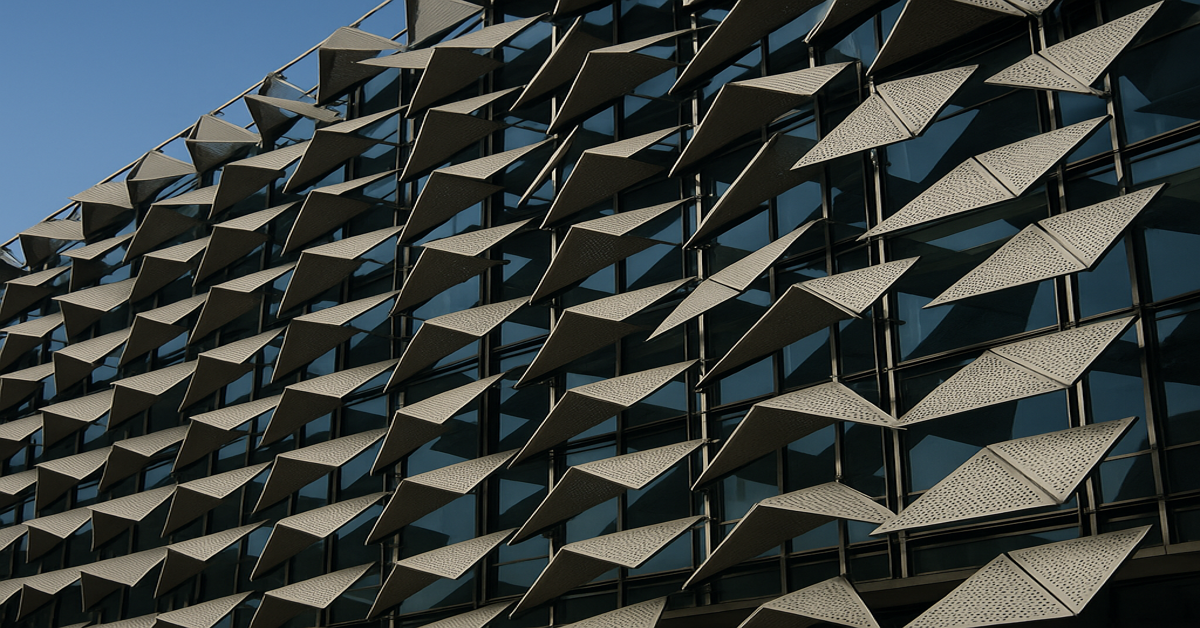
Its stainless-steel façade consists of 1,024 individual panels manufactured through a specialized robot-assisted process. The building reaches approximately 77 metres in height and has an overall area of 30,548 square metres.
Why it stands out
The Museum of the Future demonstrates how digital fabrication, advanced engineering, architecture, and Arabic calligraphy can be combined into a single building envelope.
The façade itself becomes an important part of the building’s identity rather than simply acting as an exterior covering.
5. Bosco Verticale — Milan, Italy
Bosco Verticale, or Vertical Forest, takes a very different approach to modern architecture.
Designed by Stefano Boeri Architetti, the project consists of two residential towers in Milan’s Porta Nuova district. The towers incorporate hundreds of trees along with thousands of shrubs and other plants.
The concept is based on integrating vegetation into a high-density residential environment rather than separating buildings from nature.
Why it is innovative
Bosco Verticale explores the idea of vertical urban forestry.
Instead of expanding cities horizontally to create more green space, the project integrates vegetation directly into the architecture. The planting strategy is also adapted to factors such as façade orientation and sunlight exposure.
This approach has influenced discussions around green buildings, biophilic architecture, urban biodiversity, and sustainable residential design.
6. The Interlace — Singapore
The Interlace presents another alternative to conventional high-rise residential architecture.
Rather than arranging housing as a collection of isolated vertical towers, the project uses 31 apartment blocks stacked in a hexagonal arrangement around large courtyards. The arrangement creates interconnected gardens, communal spaces, and recreational areas.
The project demonstrates how high-density housing can be organized around horizontal connections and shared outdoor spaces.
Architectural innovation
The Interlace is particularly interesting because its innovation comes from urban planning and spatial organization, not simply from an unusual façade.
It explores how apartment buildings can provide:
- Shared gardens
- Communal spaces
- Natural ventilation opportunities
- Outdoor recreation
- Stronger connections between residents
- A landscape-like residential environment
7. Eden Project — Cornwall, United Kingdom
The Eden Project demonstrates how innovative architecture can respond directly to an unusual site.
The project was built inside a former clay mine and features large geodesic Biomes designed by Grimshaw Architects. The structures use lightweight ETFE cushions and steel space frames to create large enclosed environments for different ecosystems.
The Biomes were influenced by geodesic structures and even by the geometry of soap bubbles, which helped the designers respond to the irregular shape of the former clay pit.
Why it is important
The Eden Project is an example of architecture inspired by nature and landscape regeneration.
It demonstrates that innovative architecture does not always require a skyscraper or futuristic city site. A building can be innovative because of how it transforms a damaged landscape and creates a new relationship between architecture and ecology.
8. The Core at Eden Project — Cornwall, United Kingdom
Another interesting example at Eden is the Core building.
Its roof structure was inspired by the growth pattern of a sunflower, using mathematical relationships associated with the Fibonacci sequence. The building also incorporates materials and construction strategies designed to reduce environmental impact.
The Core shows how biomimicry in architecture can influence both visual form and structural thinking.
Rather than copying nature simply for appearance, biomimetic architecture looks at natural systems and asks whether their underlying principles can inspire better design.
What Makes a Modern Building Innovative?
Innovation in architecture can take many forms. A building does not have to look futuristic to be technologically or environmentally advanced.
1. Innovative structural engineering
Buildings such as CCTV Headquarters demonstrate how structural systems can allow architects to move beyond conventional tower forms.
2. Computational and digital design
Complex buildings such as the Heydar Aliyev Center rely on advanced digital processes to coordinate complicated geometry and construction systems.
3. Sustainable architecture
Projects such as Bosco Verticale and the Eden Project explore different ways of integrating nature, vegetation, energy efficiency, and environmental considerations into architecture.
4. Advanced building materials
Modern architecture increasingly uses engineered materials, high-performance façades, lightweight systems, and digitally fabricated components.
The Museum of the Future, for example, uses a highly customized stainless-steel façade manufactured through a specialized process.
5. Architecture that responds to its surroundings
Harbin Opera House responds to its landscape and climate, while the Eden Project transforms a former industrial site into a major environmental and educational destination.
The Role of Technology in Modern Architecture
Technology has changed how architects design and construct complex buildings.
Computer-aided design, parametric modelling, digital fabrication, structural simulation, advanced materials, and robotic manufacturing allow architects to explore geometries that would have been considerably more difficult to design or construct using traditional methods.
However, technology alone does not make a building innovative.
The strongest projects generally combine technology with a clear architectural idea. The technology becomes a tool for solving a problem, improving performance, responding to the site, or creating a new spatial experience.
Sustainable Architecture Is Becoming More Important
One of the major directions in contemporary architecture is the integration of environmental thinking into building design.
This can include:
- Green façades
- Vertical planting
- Passive design
- Energy-efficient envelopes
- Natural ventilation
- Renewable energy
- Recycled materials
- Low-impact construction
- Rainwater management
- Landscape integration
- Adaptive reuse
The Eden Project, for example, uses lightweight ETFE cushions in its Biomes, while its wider architectural strategy incorporates insulation, renewable energy and other environmental measures.
Bosco Verticale takes another approach by incorporating substantial vegetation directly into residential towers.
Modern Architecture Is More Than an Unusual Shape
It is easy to associate innovative architecture with dramatic curves, unusual skyscrapers, and futuristic façades.
But architectural innovation can also be hidden.
A building may be innovative because it:
- Uses less material
- Requires less energy
- Reuses an existing structure
- Responds to extreme climate conditions
- Improves urban biodiversity
- Creates better public spaces
- Solves a difficult structural problem
- Uses new construction technology
- Connects architecture with its landscape
This broader definition makes it easier to understand why modern architectural innovation is happening across many different building types.
The Future of Innovative Architecture
The next generation of modern buildings is likely to combine several disciplines rather than relying on architecture alone.
Artificial intelligence, computational design, robotics, advanced materials, prefabrication, low-carbon construction, renewable energy, and nature-based design are increasingly influencing how buildings are imagined and delivered.
The challenge will be finding the right balance between visual ambition, construction cost, environmental performance, human comfort, and long-term adaptability.
The most interesting future buildings may therefore not simply be the ones that look unusual. They may be the ones that solve difficult architectural and environmental problems in ways that can be applied more widely.
Frequently Asked Questions
What are some of the world’s most innovative modern buildings?
Examples include the Heydar Aliyev Center in Baku, CCTV Headquarters in Beijing, Harbin Opera House in China, Museum of the Future in Dubai, Bosco Verticale in Milan, The Interlace in Singapore, and the Eden Project in Cornwall. Each demonstrates a different approach to architectural innovation.
What makes a building innovative?
Innovation can come from structural engineering, materials, digital design, sustainability, spatial planning, construction technology, or the relationship between a building and its environment.
What is the most futuristic type of modern architecture?
Futuristic architecture can include fluid forms, parametric façades, advanced structural systems, digital fabrication, smart-building technology, and experimental materials. There is no single architectural style that defines the future.
How is technology changing architecture?
Digital modelling, computational design, simulation, robotic fabrication, and advanced manufacturing allow architects and engineers to develop increasingly complex forms and building systems.
What is sustainable modern architecture?
Sustainable modern architecture aims to reduce environmental impact while creating comfortable and functional buildings. It can involve energy efficiency, passive design, renewable energy, responsible materials, water management, biodiversity, and adaptive reuse.
What is biomimicry in architecture?
Biomimicry involves studying natural forms, systems, or processes and using their principles to inspire human design. The Core at the Eden Project, for example, takes inspiration from the structure and growth pattern of a sunflower.
Why are modern buildings using more plants?
Vegetation can contribute to the relationship between buildings and nature, while green-building strategies can support biodiversity and environmental goals. Bosco Verticale is a prominent example of integrating extensive vegetation into residential architecture.
Is innovative architecture always expensive?
Not necessarily. Innovation can involve a new planning strategy, adaptive reuse, passive design, material efficiency, or a better response to the site. Expensive materials and complex shapes are only one form of architectural experimentation.