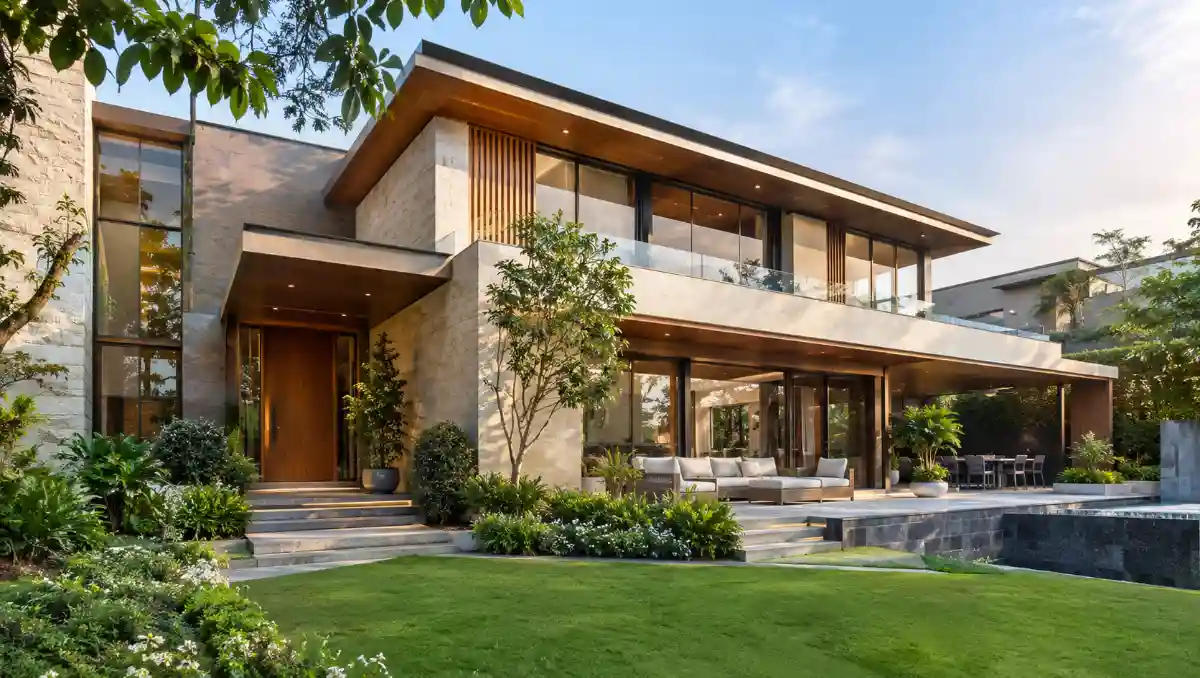
A modern house facade does much more than create a good first impression. It establishes the architectural identity of the home while influencing daylight, privacy, weather protection and the connection between indoor and outdoor spaces.
The most successful modern exteriors are not necessarily the most complicated. Clean proportions, carefully positioned windows, a restrained material palette and thoughtful landscaping can make a relatively simple home look distinctive.
If you are building, renovating or simply collecting inspiration, these 25 modern house facade ideas show different ways to combine form, materials, windows, shading, greenery and lighting without turning the exterior into a collection of unrelated design features.
What Makes a House Facade Look Modern?
Modern facade design generally favors clarity over excessive decoration.
Common characteristics include geometric forms, clean rooflines, large or strategically positioned windows, strong indoor-outdoor connections and a limited palette of complementary materials.
However, there is no single formula for a modern home.
As explained in our guide to modern architecture and home design, successful contemporary architecture should respond to its site, climate and occupants rather than simply reproduce a fashionable appearance.
Here are 25 approaches worth considering.
1. Clean White Facade With Dark Window Frames
One of the simplest modern exterior combinations is a light rendered facade paired with dark window and door frames.
The contrast emphasizes the openings and architectural geometry without requiring numerous decorative materials.
Warm landscaping, timber entrance details or textured paving can prevent a monochrome exterior from feeling too clinical.
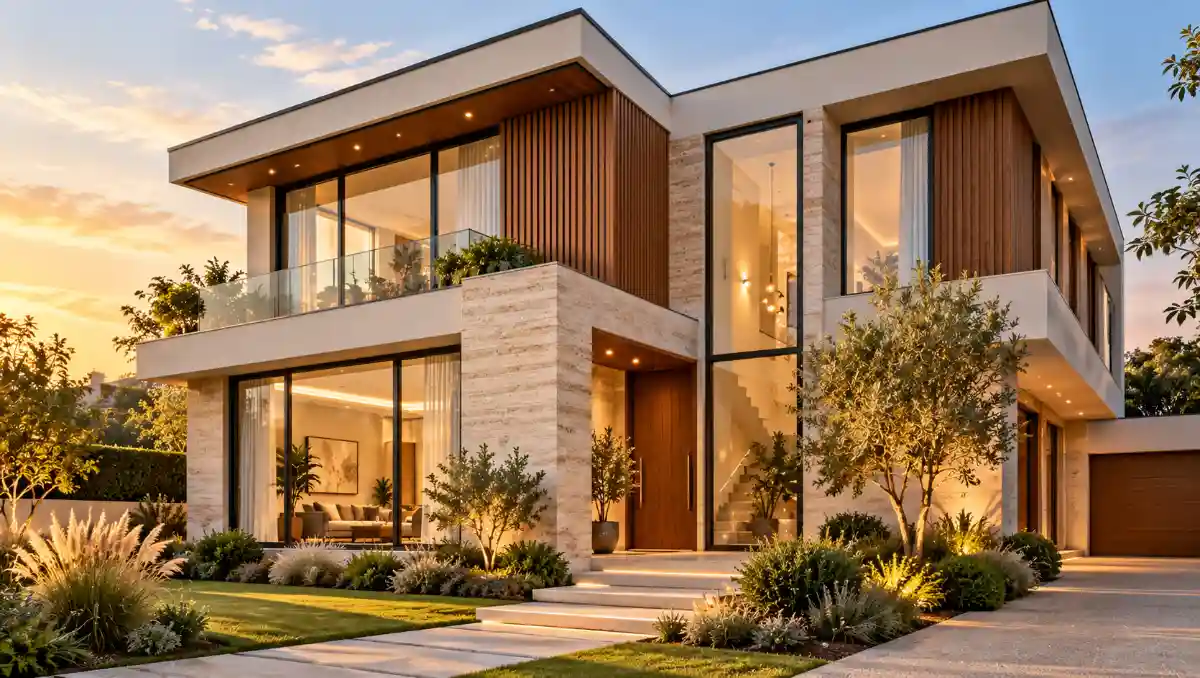
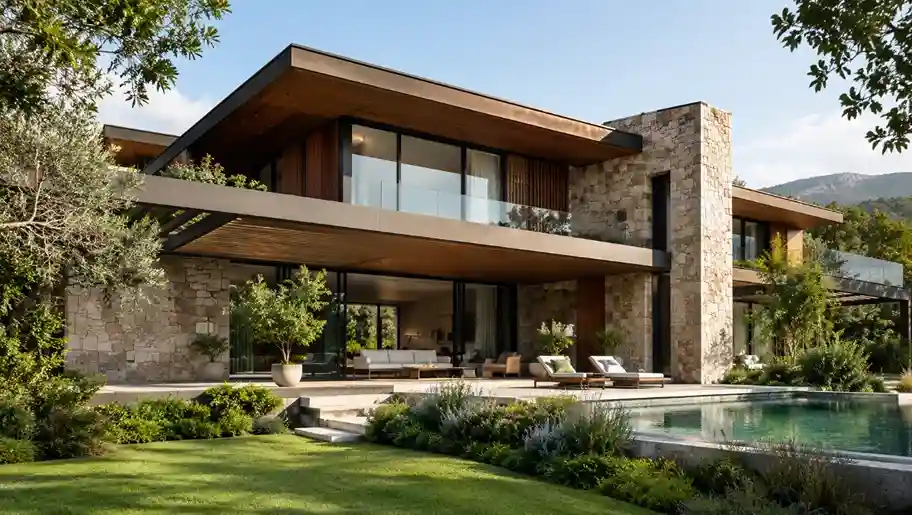
2. Natural Stone and Smooth Render
Natural stone introduces texture and visual weight to otherwise minimalist architecture.
Instead of covering every exterior wall, consider using stone strategically around an entrance, ground-floor volume, chimney or feature wall.
Pairing textured stone with smooth render creates contrast while maintaining a relatively restrained palette.
3. Warm Timber Accents
Timber can soften the hard lines of contemporary architecture.
Use it selectively on entrance walls, soffits, screens, garage doors or recessed sections rather than automatically covering the entire building.
Exterior timber requires a finish, species and detailing appropriate for the local climate. Maintenance expectations should be considered from the beginning.
4. Large Windows as Part of the Architecture
Windows should not simply be holes cut into a facade.
Their dimensions, alignment and spacing can become an important part of the exterior composition.
Large glazed openings can connect living spaces with gardens and views, while smaller openings can protect privacy in bedrooms or street-facing rooms.
If slim contemporary frames suit your project, our guide to modern aluminium window design explores window configurations, frame finishes and practical design considerations.
Window performance should always be chosen for the climate, orientation and local requirements—not appearance alone.
5. Minimalist Monochrome Exterior
A facade using variations of one color can create a sophisticated architectural appearance.
Think warm white, charcoal, pale grey or earthy beige applied across different textures.
The key is creating depth through recesses, projections, shadows and material finishes rather than relying entirely on color contrast.
6. Mixed-Material Facade
Modern houses frequently combine materials, but more is not necessarily better.
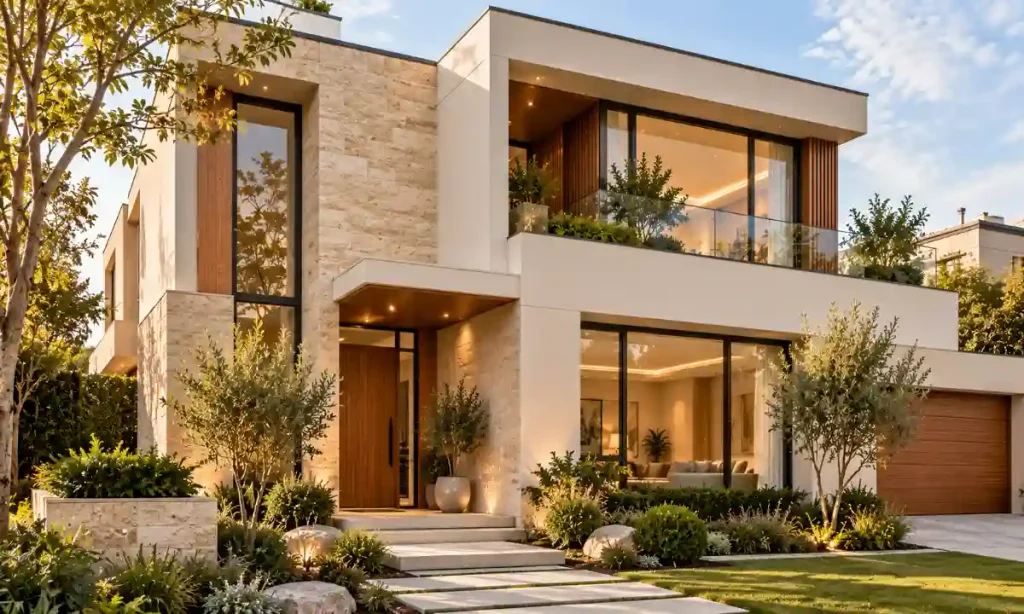
Stone, render and timber can work beautifully together when each material has a clear architectural purpose.
Similarly, brick can pair with metal or concrete.
Our guide to types of exterior wall cladding explains the characteristics and considerations of common facade materials in greater detail.
Keep transitions intentional. Random strips of unrelated materials can make an exterior look unnecessarily busy.
7. Contemporary Brick Facade
Brick is not limited to traditional architecture.
Modern brick houses can use simple geometric volumes, deep window reveals, restrained detailing and unusual bond patterns to give a familiar material a contemporary identity.
Brick can also introduce warmth to homes dominated by glass, metal or concrete.
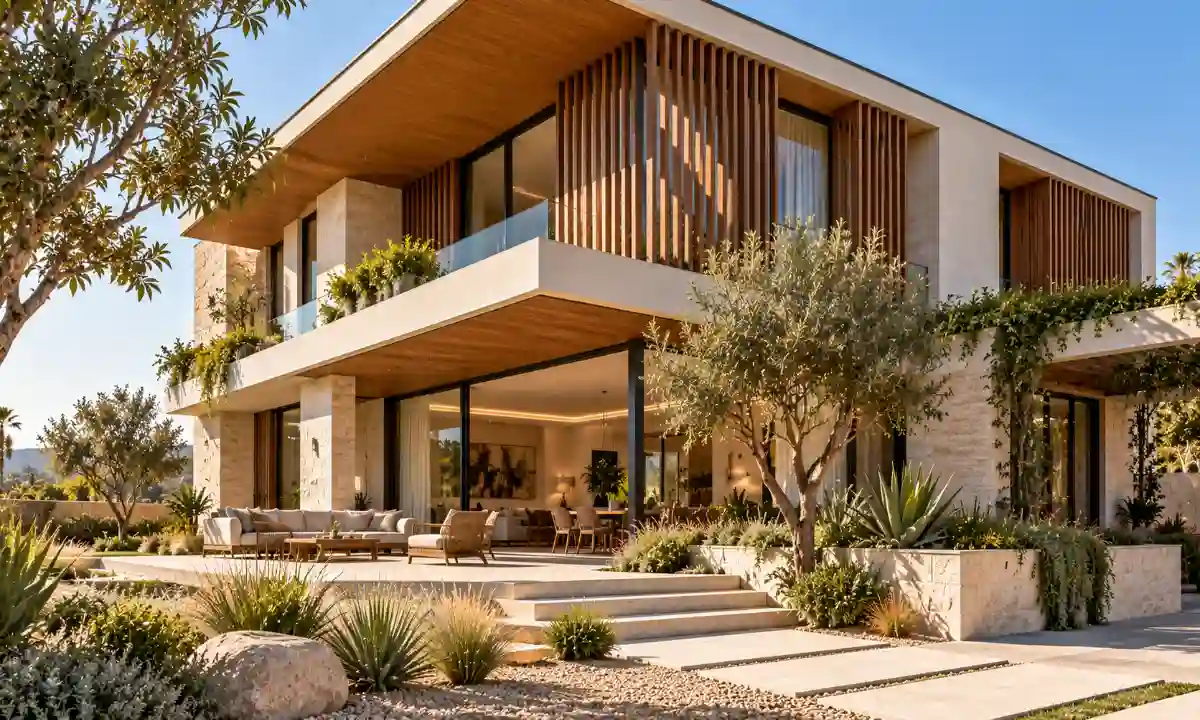
8. Vertical Timber Screens
Vertical screens can add rhythm and depth to a facade while serving practical purposes.
Depending on their position and construction, screens may help provide privacy, filter views or shade glazing.
They are particularly effective around balconies, upper-floor windows and entrance areas.
The spacing should be designed around the actual privacy or shading requirement rather than purely for decoration.
9. Dramatic Cantilevered Upper Floor
A projecting upper level can give a modern house a strong sculptural identity.
It can also create a sheltered area beneath for an entrance, terrace or parking space.
However, a genuine cantilever is a structural decision, not simply an aesthetic feature. It requires appropriate engineering and careful detailing.
10. Flat or Low-Slope Roof Expression
Flat and visually low-slope rooflines are strongly associated with contemporary homes.
They allow simple rectangular volumes to become the primary architectural language.
The apparently simple appearance can conceal important technical requirements, including drainage, waterproofing, insulation and parapet detailing.
Design the roof for local rainfall, snow and climate conditions rather than selecting it only for its appearance.
11. Modern Gabled Facade
Modern architecture does not require a flat roof.
A simple gabled form can look distinctly contemporary when combined with minimal eaves, large glazing and a restrained material palette.
This approach works particularly well when designers want a familiar house silhouette with modern detailing.
12. Concrete-Look Exterior
Concrete can give a house a robust, sculptural appearance.
Depending on the project, the effect might come from exposed structural concrete or a suitable facade finish designed to create a concrete-like appearance.
Pair it with timber, greenery or warm lighting to soften the visual weight.
13. Courtyard-Focused Facade
Not every modern home needs maximum transparency toward the street.
On dense urban sites, the public-facing facade can remain relatively private while the house opens toward an internal courtyard.
This creates an interesting contrast between a controlled street elevation and a brighter, greener interior environment.
14. Double-Height Entrance
A taller entrance volume can establish a clear focal point on a two-storey facade.
The effect does not necessarily require an enormous front door. Height can be expressed through a recessed wall, vertical window, canopy or continuous cladding element.
Keep the scale appropriate to the overall house.
15. Deep Window Reveals
Recessing windows creates natural shadow lines that add depth to an otherwise simple facade.
Deep reveals can also make openings feel integrated into the architecture rather than applied to the surface.
Their technical design should account for waterproofing, insulation and local weather exposure.
16. Integrated Balcony Design
A modern balcony should feel like part of the building composition.
Instead of attaching an unrelated railing and slab to the facade, align the balcony with surrounding walls, windows, screens and materials.
Recessed balconies can provide a particularly clean appearance while offering additional privacy and weather protection.
17. Black Modern House Exterior
A dark facade can create a striking architectural statement, especially in natural or wooded settings.
Charcoal cladding, dark brick, blackened timber and metal are possible approaches.
But color has performance implications.
Dark surfaces generally absorb more solar radiation than lighter ones, so material choice, insulation, climate and exposure need to be considered alongside aesthetics.
18. White Exterior With Natural Wood
White and timber remain a popular combination because they balance visual simplicity with warmth.
Instead of scattering timber everywhere, use it to highlight meaningful areas such as the entrance, garage door, balcony or sheltered terrace.
Repeating the same timber tone elsewhere in the landscape or exterior details can make the composition feel intentional.
19. Green Facade and Integrated Planting
Architecture and planting do not need to be treated as separate layers.
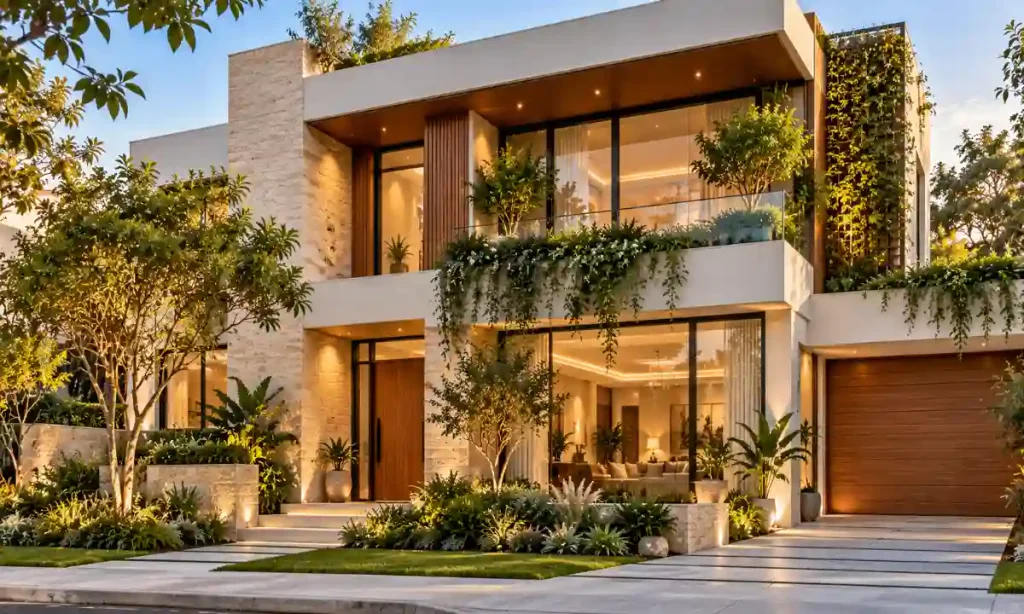
Planters, climbing plants, courtyards and green screens can become part of the facade composition.
Our guide to biophilic design buildings explores the wider relationship between architecture and nature.
Plant selection should account for climate, mature size, irrigation, maintenance and potential interaction with the building envelope.
20. Horizontal Lines for a Wider Appearance
Strong horizontal elements can visually emphasize the width of a house.
Long balconies, canopies, roof edges and aligned windows can all reinforce this effect.
This approach works particularly well on wide plots and low-profile homes.
For a narrow house, however, excessive horizontal emphasis may not suit the proportions.
21. Vertical Elements for a Narrow Facade
On narrower urban plots, vertical design elements can create a stronger sense of height.
Tall windows, vertical cladding, fins and entrance features can draw the eye upward.
Rather than fighting a narrow site, use its proportions as part of the architectural character.
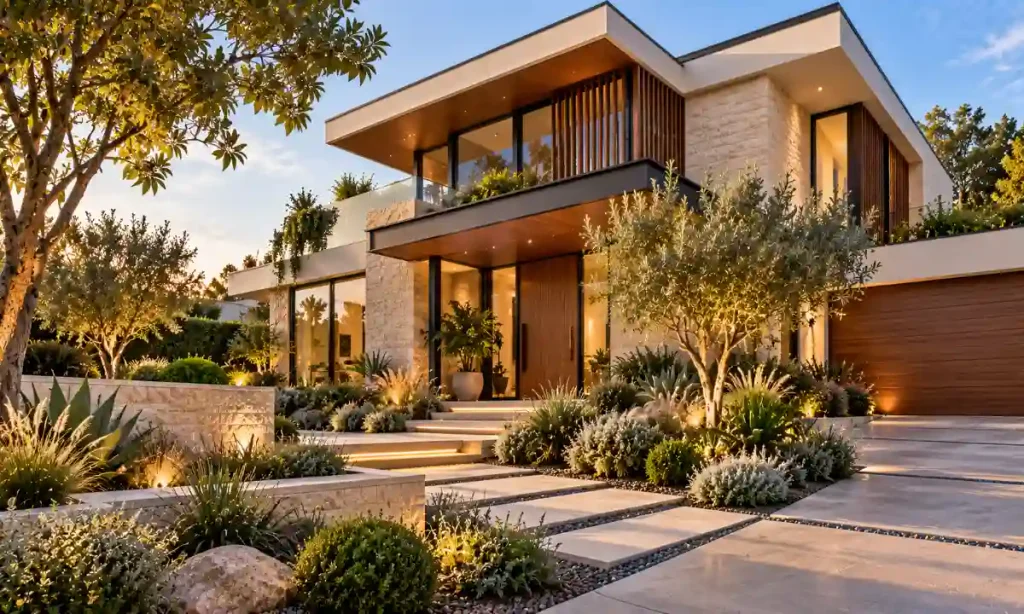
22. Recessed Entrance With Warm Lighting
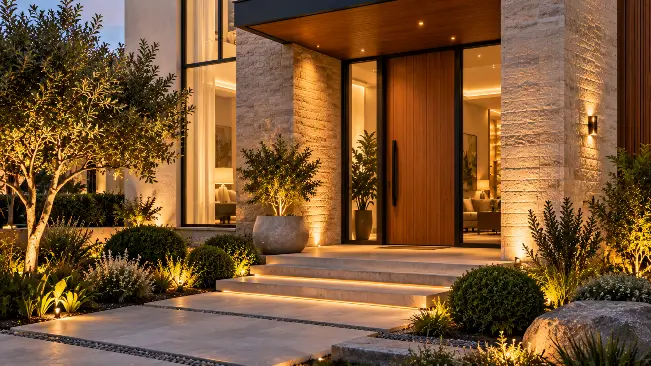
A recessed entrance creates depth and naturally establishes hierarchy.
Add a change of material, a sheltered canopy or carefully positioned lighting to make the doorway easy to identify.
Exterior lighting is most effective when it reveals architecture rather than flooding every surface with brightness.
Screens can transform a facade while controlling visibility.
Metal panels, masonry screens, timber battens and other systems can create patterns of light and shadow while providing different degrees of privacy.
They can be especially useful for balconies, staircases and street-facing windows.
Any exterior screen must be appropriately engineered and detailed for weather, wind and maintenance.
24. Climate-Responsive Shading
One of the best modern facade ideas is also one of the most practical: make shading part of the architecture.
Roof overhangs, canopies, fins, screens and recessed windows can help control direct sunlight when properly designed for the orientation and climate.
The U.S. Department of Energy notes that window placement, glazing and shading need to work together: overhangs, fixed shades, louvers and screens can help manage unwanted heat and glare.
That is an important reminder that a modern facade should perform well, not simply photograph well.
25. Landscape-Integrated Modern Facade
The final idea involves looking beyond the building itself.
A beautiful facade can lose much of its impact when the driveway, planting, paths, boundary walls and entrance are designed independently.
Instead, treat the front landscape as part of the architecture.
Repeat materials selectively, align pathways with the entrance and choose planting that complements rather than conceals the building.
The result can feel sophisticated without making the house itself unnecessarily elaborate.
How to Choose Materials for a Modern House Facade
Material selection should begin with performance rather than appearance alone.
Consider:
Local climate
Rain and moisture exposure
Sun exposure
Freeze-thaw conditions where relevant
Fire requirements
Durability
Maintenance
Installation expertise
Local availability
Complete installed cost
The exterior wall is a system. Cladding is only one component, and moisture management, drainage, flashing and the layers behind the visible finish are critical to long-term performance.
For example, properly designed rainscreen assemblies provide a drainage cavity behind exterior cladding so incidental moisture can drain and the assembly can dry.
Building requirements differ considerably between the USA, UK, Canada, Australia, Europe and other markets, so facade assemblies should always comply with applicable local regulations.
How Many Materials Should a Modern Facade Use?
There is no universal number, but restraint usually produces a more coherent result.
Two or three complementary primary finishes are often enough to create contrast.
For example:
Stone + render + timber
or
Brick + metal + glass
The objective is not to display as many materials as possible. Each material should reinforce a volume, entrance, opening or architectural feature.
Windows Can Make or Break the Facade
Windows affect both the appearance and performance of a house.
Before choosing glazing simply because a large glass wall looks attractive, consider orientation, privacy, views, daylight, glare and solar heat gain.
The U.S. Department of Energy notes that glazing area, climate, shading and daylighting all interact in building performance.
That means the ideal window strategy for a cool northern climate may be very different from the best approach for a hot, sunny location.
Common Modern Facade Design Mistakes
Using Too Many Materials
Five or six competing finishes can destroy the clarity that makes contemporary architecture appealing.
Designing the Exterior Separately From the Floor Plan
Window positions should relate to real rooms, views, privacy and daylight requirements.
Ignoring Climate
An enormous unshaded glass facade may work very differently depending on its orientation and location. External shading can help control unwanted solar heat gain when appropriately designed.
Forgetting Maintenance
Some beautiful materials weather naturally; others require regular cleaning, sealing, coating or refinishing.
Understand the long-term requirements before specifying them.
Copying a Facade Without Considering the Site
A design created for a wooded Canadian site may not perform appropriately on an exposed Australian coast or a dense London street.
Use reference images for inspiration, not as construction instructions.
Modern Facade Design: Beauty and Performance Should Work Together
The strongest modern house facades combine visual clarity with practical building performance.
A deep overhang, for example, can become a defining architectural feature while also providing shade. Carefully positioned glazing can frame views and provide daylight while respecting privacy.
This is where modern exterior design becomes more than styling.
Every major element can perform multiple roles.
Final Thoughts
The best modern house facade ideas do not depend on extravagant materials or complicated shapes.
A carefully proportioned house with good windows, a clear entrance, two or three complementary materials, appropriate shading and thoughtful landscaping can be more convincing than a facade filled with decorative features.
Start with the site and climate. Develop the internal layout. Position windows according to daylight, privacy and views. Then use materials, screens, balconies, lighting and landscaping to strengthen the architectural composition.
When appearance and performance are designed together, the result is a modern exterior that can remain appealing long after individual facade trends have changed.
Frequently Asked Questions
What is the best material for a modern house facade?
There is no universally best material. Stone, brick, timber, metal, render, fiber cement, terracotta and other cladding systems can all suit modern homes. The right choice depends on climate, architecture, budget, maintenance and local construction requirements.
How can I make my house facade look modern?
Simplify the material palette, create a clear entrance, improve window proportions, remove unnecessary decoration and use landscaping and lighting as part of the overall composition. A full structural redesign is not always necessary.
What colors work well for modern house exteriors?
Warm white, grey, charcoal, earthy neutrals and natural material tones are common, but the best palette depends on the architecture and surroundings. Contrast can be introduced through windows, doors or selected facade elements.
Are large windows necessary for a modern facade?
No. Large windows are common in contemporary architecture, but modern design is more about proportion, functionality and composition. Smaller strategically positioned openings can be equally effective, particularly where privacy or climate demands them.
How do you make a modern facade look warm rather than cold?
Natural stone, timber tones, brick, textured finishes, warm exterior lighting and landscaping can soften clean contemporary forms without sacrificing their modern character.
Is a modern facade expensive?
Not necessarily. Complexity, specialist construction, glazing quantity and material selection can affect cost more than the word “modern.” A simple facade with good proportions and a limited material palette can be highly effective.