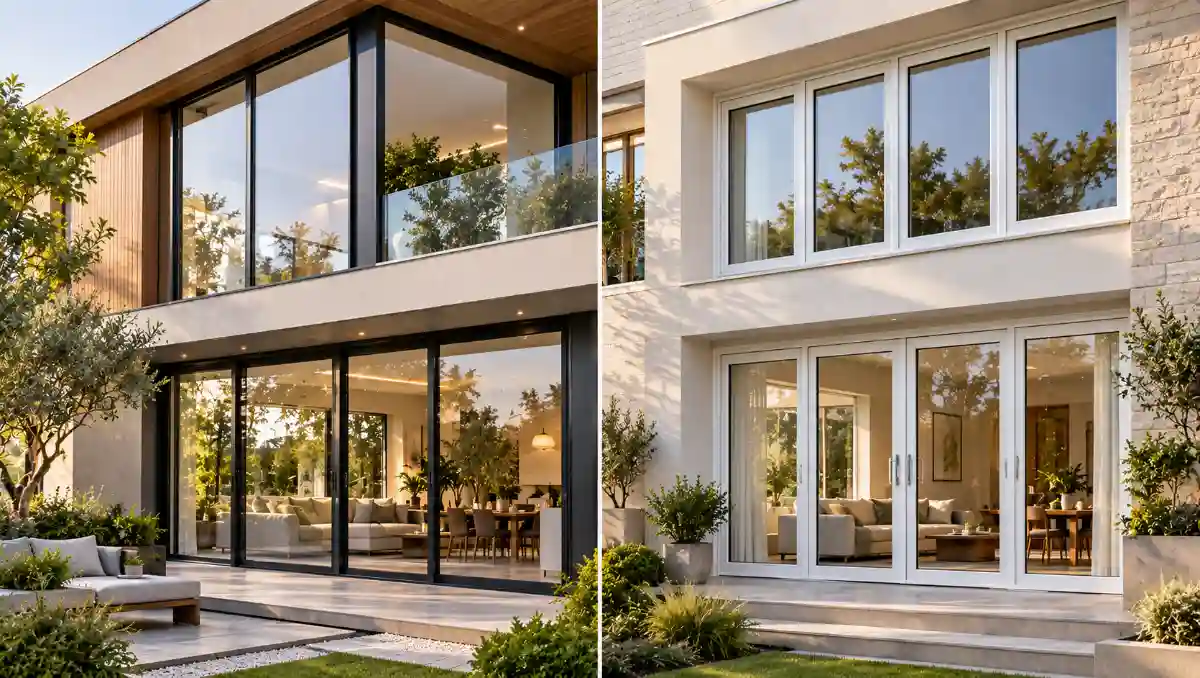
Choosing between aluminium vs uPVC windows can have a significant impact on the appearance, comfort and long-term performance of a home.
Aluminium windows are widely associated with slim frames, large areas of glass and contemporary architecture. uPVC windows, meanwhile, are popular for their thermal insulation, low maintenance requirements and value for many residential projects.
But which one is actually better?
There is no single answer that works for every home. The right choice depends on factors such as climate, window size, glazing, architectural style, budget and expected performance.
This guide compares aluminium and uPVC windows across cost, durability, energy efficiency, maintenance, design, security and other important factors to help you make an informed decision.
Aluminium vs uPVC Windows: Quick Comparison
Feature
Aluminium Windows
uPVC Windows
Structural strength
Excellent
Good
Frame profile
Typically slimmer
Typically broader
Large openings
Excellent
System-dependent
Thermal insulation
Very good with thermal break
Naturally good
Initial cost
Often higher
Often lower
Maintenance
Low
Low
Colour options
Extensive
Good
Modern aesthetics
Excellent
Good
Large glass areas
Excellent
Good
Energy efficiency
Excellent when properly specified
Excellent when properly specified
Best suited for
Large openings and contemporary architecture
Standard residential windows and insulation-focused projects
The comparison should not stop at frame material. Glazing, seals, hardware, installation and the overall window specification can influence performance just as much as the frame itself.
What Are Aluminium Windows?
Aluminium windows use extruded aluminium profiles to form the window frame and sash.
One of aluminium’s biggest advantages is its high strength-to-weight ratio. This allows manufacturers to create relatively slim frames capable of supporting substantial areas of glass.
As a result, aluminium windows are commonly used in contemporary homes where large openings and minimalist architectural details are important.
Common aluminium window styles include:
Casement windows
Sliding windows
Fixed windows
Awning windows
Tilt-and-turn windows
Large sliding doors
Bi-fold systems
Floor-to-ceiling glazing
If contemporary window design is one of your priorities, explore our Aluminium Window Design guide for modern configurations and architectural ideas.
What Are uPVC Windows?
uPVC stands for unplasticised polyvinyl chloride.
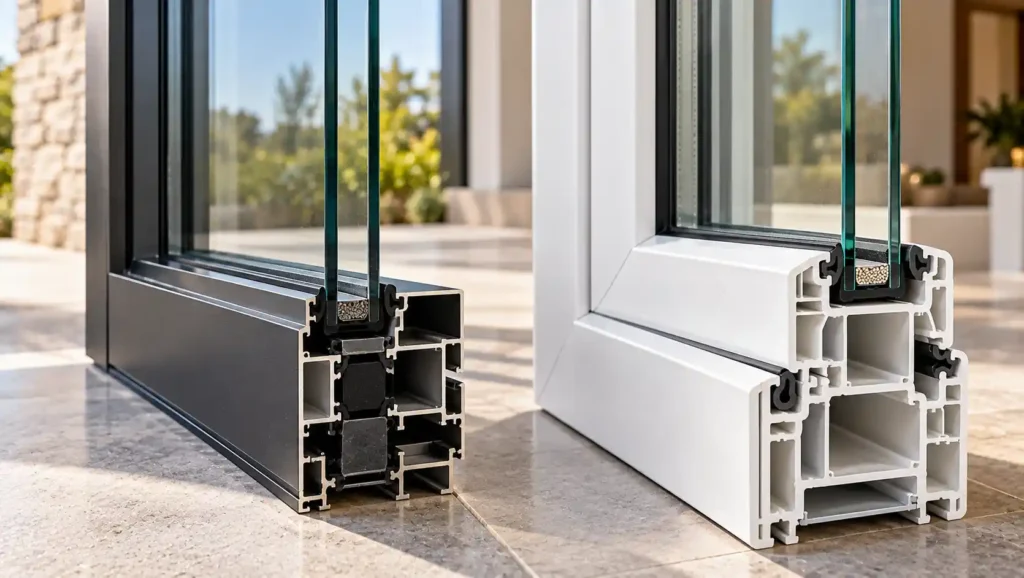
Unlike aluminium, it is not a metal. Modern uPVC window profiles typically use multiple internal chambers designed to improve structural and thermal performance.
Some systems also incorporate reinforcement where additional strength is required.
uPVC is widely used in residential construction because it combines good insulation with relatively straightforward maintenance.
Common uPVC window configurations include:
Casement windows
Sliding windows
Tilt-and-turn windows
Fixed windows
Bay windows
Combination windows
Residential doors
Aluminium vs uPVC Windows: Which Is Stronger?
When structural strength is a major consideration, aluminium generally has an advantage.
Its strength enables well-engineered window systems to accommodate substantial glazing while maintaining relatively slim profiles.
This makes aluminium particularly attractive for:
Large living-room windows
Wide sliding doors
Floor-to-ceiling glazing
Balcony openings
Contemporary extensions
Large architectural windows
uPVC is still strong enough for many conventional residential windows.
Depending on the system, reinforcement may be incorporated when larger dimensions or additional structural capacity are required.
For normal residential openings, both materials can perform effectively when properly engineered.
For very large openings, however, aluminium often offers greater design flexibility.
Aluminium vs uPVC Windows: Durability
Frame construction influences sightlines, thermal performance and the types of openings each window system can accommodate.
Durability depends on more than the material itself.
Profile quality, hardware, glazing, seals, surface treatment, installation and environmental exposure all affect how a window performs over time.
Aluminium Window Durability
Aluminium does not rust in the same way as ordinary steel.
Modern aluminium window frames can use protective finishes such as powder coating or anodising to achieve the desired appearance and provide additional surface protection.
Aluminium also has good dimensional stability, which is particularly useful for large window systems.
Its long-term performance depends on factors including:
Profile quality
Surface treatment
Hardware quality
Drainage
Weather seals
Installation
Environmental exposure
Routine maintenance
uPVC Window Durability
Quality uPVC windows are designed to withstand normal residential weather exposure without requiring regular painting.
However, not all uPVC systems are identical.
Long-term performance can depend on:
Profile quality
UV stabilisation
Reinforcement
Hardware
Seals
Manufacturing quality
Installation
This is why homeowners should compare actual window systems rather than judging every product solely by whether it is aluminium or uPVC.
Which Is More Energy Efficient?
Energy efficiency is one of the biggest factors in the aluminium vs uPVC windows debate.
uPVC Thermal Performance
Modern aluminium frames can overcome much of their natural conductivity disadvantage through thermal-break technology. See our complete guide to thermal break aluminium windows to understand how these insulated frames work and when they are worth the additional cost.
Multi-chamber profile construction can further reduce heat transfer through the frame.
This makes uPVC attractive for homeowners who place a high priority on thermal insulation.
Aluminium Thermal Performance
Aluminium conducts heat more readily.
However, modern high-performance aluminium windows can incorporate a thermal break between the internal and external aluminium sections.
This thermal barrier reduces direct heat transfer through the frame.
As a result, a properly designed thermally broken aluminium window can perform very differently from a basic non-thermally broken aluminium system.
For a deeper explanation of glazing, thermal breaks, U-values and solar heat gain, see our Energy-Efficient Windows guide.
Glass Matters as Much as the Frame
A common mistake is comparing aluminium and uPVC based only on the frame.
In many windows, glass represents most of the exposed area.
It would be misleading to assume Window A automatically provides better whole-window energy performance simply because its frame is uPVC.
When comparing windows, consider:
Whole-window U-value or U-factor
Solar Heat Gain Coefficient (SHGC), where relevant
Double or triple glazing
Low-e coatings
Gas-filled cavities where used
Spacer technology
Frame construction
Air leakage
Weather seals
Installation quality
The best energy-efficient window should therefore be selected as a complete system, not by frame material alone.
Aluminium vs uPVC Windows: Cost
Cost is another major difference between aluminium and uPVC windows.
In many markets, standard uPVC windows tend to have a lower initial cost than comparable premium aluminium systems.
However, there is no universal price that applies worldwide.
Window costs can vary significantly depending on:
Country
Window dimensions
Opening style
Frame system
Profile quality
Glass specification
Double or triple glazing
Hardware
Locks
Colour and finish
Thermal-break technology
Installation complexity
Building accessibility
This is why comparing windows only on their headline price can be misleading.
Compare Like With Like
Suppose one supplier quotes a standard uPVC window with basic glazing, while another quotes a thermally broken aluminium system with low-e glazing and premium hardware.
The price difference does not provide a fair comparison between aluminium and uPVC.
Where possible, request quotations based on the same window dimensions, glazing specification, hardware and performance requirements.
Which Offers Better Long-Term Value?
Initial purchase price is only one part of window ownership.
A more useful calculation considers:
Purchase + installation + maintenance + repairs + energy performance + expected service life
A premium aluminium system may make sense when large openings, slim frames and architectural aesthetics are priorities.
On the other hand, paying more for those characteristics may offer limited value if your home primarily uses conventional window sizes and your priorities are insulation and affordability.
The best option is therefore the one offering the strongest whole-life value for your specific project.
Aluminium vs uPVC Windows: Maintenance
Both materials are considered relatively low-maintenance.
Neither normally requires the regular repainting associated with some traditional frame materials.
Maintaining Aluminium Windows
Typical maintenance includes:
Cleaning the frames
Keeping drainage channels clear
Inspecting weather seals
Checking locks and handles
Maintaining rollers and hinges where applicable
Inspecting the finish in aggressive environments
Maintaining uPVC Windows
Typical maintenance includes:
Cleaning profiles
Inspecting seals
Keeping drainage paths clear
Checking hinges
Maintaining locks and handles
Inspecting perimeter sealant
Neither material should be considered completely maintenance-free.
Windows contain moving hardware, seals and drainage components that benefit from periodic inspection.
Which Looks Better?
Design preference is subjective, but aluminium and uPVC create noticeably different architectural appearances.
Aluminium Windows
Aluminium is strongly associated with contemporary architecture because it can provide:
Slim sightlines
Large visible glass areas
Crisp frame geometry
Extensive colour options
Matte finishes
Textured finishes
Dark architectural colours
Large-format openings
For minimalist homes, aluminium can help reduce the visual dominance of the frame.
uPVC Windows
Modern uPVC systems are available in a growing range of finishes.
Options can include:
White
Grey
Black
Neutral tones
Wood-effect finishes
Dual-colour configurations
uPVC frames are generally broader than comparable slim aluminium profiles, but this may have little visual impact on conventional residential openings.
Windows should also complement the architecture of the entire building. Our Modern Architecture and Home Design guide explores how glazing, daylight, materials, orientation and façade composition work together.
Which Provides More Natural Light?
Aluminium can have an advantage where maximising visible glass is important.
Because strong aluminium profiles can often be made relatively slim, more of the overall opening may be occupied by glass.
This can be particularly noticeable in:
Picture windows
Large sliding doors
Corner windows
Floor-to-ceiling glazing
Garden-facing living spaces
However, more glass is not automatically better.
Window orientation, glare, privacy, shading and solar heat gain also need to be considered.
Good window design balances daylight with thermal comfort.
Which Is Better for Large Windows?
For very large openings, aluminium is generally the stronger candidate.
Its structural characteristics make it well suited to large sliding panels and expansive glazed openings.
This is one reason aluminium is frequently used in modern homes designed around indoor-outdoor living.
uPVC can also accommodate substantial windows, depending on the profile system, reinforcement, hardware and engineering.
For very large architectural glazing applications, wind load, glass weight, deflection and structural support become increasingly important.
Our guide to Types of Structural Glazing provides further background on larger architectural glazing systems.
Aluminium vs uPVC for Sound Insulation
Frame material alone does not determine how effectively a window reduces outside noise.
Acoustic performance depends heavily on:
Glass thickness
Laminated glass
Different pane thicknesses
Airspace between panes
Frame seals
Air leakage
Installation quality
Opening configuration
A properly sealed aluminium window with suitable acoustic glazing may outperform a poorly specified uPVC window.
The reverse can also be true.
If noise reduction is important, ask for tested acoustic performance for the complete window assembly.
Which Is More Secure?
Both aluminium and uPVC windows can provide good residential security when correctly designed.
Important security factors include:
Frame construction
Locking system
Hinges
Hardware
Reinforcement
Glass type
Installation
Fixing to the building opening
Aluminium’s inherent rigidity can be advantageous, but a quality reinforced uPVC system with appropriate locks and glazing can also provide strong security.
Rather than choosing solely by material, compare tested security specifications where available.
Aluminium vs uPVC Windows for Hot Climates
In hot climates, the frame is only part of the thermal-performance equation.
Solar radiation entering through glass can have a major effect on indoor temperatures.
Important considerations include:
Appropriate SHGC
Solar-control glazing
Low-e coatings
External shading
Roof overhangs
Louvres
Window orientation
Air sealing
Thermally improved frames
This means uPVC is not automatically the best choice simply because it is a better natural insulator.
A thermally broken aluminium frame combined with appropriate solar-control glazing and shading can also form part of an effective hot-climate window strategy.
Aluminium vs uPVC Windows for Cold Climates
In colder climates, limiting unwanted heat loss becomes particularly important.
uPVC’s insulating characteristics can make it attractive for heating-dominated regions.
Aluminium can also perform effectively when the system incorporates a well-designed thermal break and suitable insulated glazing.
When comparing windows for cold climates, look at the whole-window U-value rather than judging performance from the frame material alone.
Aluminium vs uPVC: Sustainability
The sustainability comparison is more complicated than simply identifying one material as environmentally friendly.
Factors worth considering include:
Raw materials
Manufacturing
Recycled content
Product lifespan
Transportation
Thermal performance
Maintenance
Repairability
End-of-life recycling
Local recycling infrastructure
Aluminium is highly recyclable and can retain useful material value when recycled.
uPVC can also be recycled through suitable collection and processing systems.
However, actual environmental outcomes depend on local infrastructure and how products are manufactured, used and eventually disposed of.
Energy performance during the life of the building also matters.
A durable window that helps reduce unnecessary heating or cooling demand may deliver environmental benefits over many years.
Advantages and Disadvantages of Aluminium Windows
Advantages
Excellent structural strength
Slim contemporary profiles
Suitable for large glazed openings
Extensive colour and finish options
Low routine maintenance
Excellent for modern architecture
Strong dimensional stability
Recyclable material
Disadvantages
Often higher initial cost
Basic aluminium conducts heat readily
High thermal performance generally requires thermal separation
Premium systems can be expensive
Poorly specified systems can create thermal bridging problems
Advantages and Disadvantages of uPVC Windows
Advantages
Good inherent thermal insulation
Often lower initial cost
Low routine maintenance
No regular painting required
Suitable for many standard residential openings
Compatible with energy-efficient glazing
Strong value for many homeowners
Disadvantages
Generally broader frame profiles
Some systems are less suitable for extremely large openings
Design flexibility can be more limited than aluminium
Product quality varies considerably
Reinforcement may be necessary for certain applications
Aluminium vs uPVC Windows: Which Should You Choose?
Neither material is universally better.
Choose Aluminium Windows If:
You prefer slim contemporary frames.
You want large areas of glass.
Your home has large window or door openings.
Modern architectural appearance is important.
You want extensive colour and finish options.
Structural strength is a priority.
You are comfortable investing in an appropriate premium system.
Choose uPVC Windows If:
Thermal insulation is a major priority.
You want to keep initial costs under control.
Your home mainly has conventional window sizes.
You prefer straightforward maintenance.
Ultra-slim sightlines are not essential.
You want good residential performance at a value-focused price.
There may also be situations where using both materials makes sense.
For example, aluminium could be selected for a large living-room sliding system where strength and slim profiles matter, while uPVC could be used for conventional bedroom windows where insulation and cost are greater priorities.
10 Things to Check Before Buying Windows
Before choosing either material, ask the supplier:
What is the whole-window U-value or U-factor?
What is the SHGC of the specified glass?
Does the aluminium system incorporate a thermal break?
What glazing configuration is included?
Is low-e glass included?
What locking system and hardware are supplied?
What warranties apply?
How does the window manage water and drainage?
How will the window be installed and sealed?
Is the system suitable for the size and exposure of the opening?
These questions provide much more useful information than simply asking whether aluminium or uPVC is better.
Final Verdict
The aluminium vs uPVC windows decision ultimately depends on what you expect from your windows.
Aluminium is particularly strong for contemporary architecture, large openings, slim profiles and expansive glazing.
uPVC is particularly attractive for good thermal insulation, straightforward maintenance and value-focused residential projects.
Energy efficiency deserves special attention.
A modern thermally broken aluminium frame with high-performance glazing can perform very differently from an older basic aluminium window. Similarly, a uPVC frame cannot compensate for inappropriate glazing, poor seals or incorrect installation.
Instead of choosing on material alone, compare the complete window system:
frame + glazing + thermal performance + solar control + hardware + sealing + installation.
That approach provides a much more reliable basis for choosing windows that suit your home’s architecture, climate, comfort requirements and budget.
Frequently Asked Questions
Which is better, aluminium or uPVC windows?
Neither is universally better. Aluminium generally offers greater structural strength, slimmer profiles and more flexibility for large openings. uPVC provides good inherent thermal insulation and is often more affordable for conventional residential windows.
Which is more energy efficient: aluminium or uPVC?
uPVC naturally has relatively low thermal conductivity. Modern aluminium windows can significantly improve thermal performance by using an effective thermal break. Glazing, seals and installation also have a major influence on whole-window energy performance.
Are aluminium windows more expensive than uPVC?
Aluminium systems often have a higher initial cost than standard uPVC windows, particularly when premium finishes, thermal breaks or large glazing systems are specified. Actual costs vary considerably by market and project specification.
Which is better for large windows?
Aluminium is generally preferred for very large windows and glazed doors because its structural strength can support substantial glazing while maintaining relatively slim frame profiles.
Can aluminium windows be energy efficient?
Yes. Thermally broken aluminium frames combined with suitable insulated glazing, low-e coatings and effective weather seals can form part of a highly energy-efficient window system.
Is uPVC better for hot climates?
Not necessarily. Frame insulation is only one consideration in hot climates. Solar heat gain through the glass, shading, window orientation, air leakage and glazing specification can have a major effect on indoor comfort.
Which material requires less maintenance?
Both aluminium and uPVC require relatively little routine maintenance. Frames should still be cleaned periodically, while drainage channels, weather seals, locks, hinges and other hardware should be inspected.
Which looks more modern?
Aluminium is often preferred for contemporary architecture because its strength allows relatively slim profiles and large glass areas. Modern uPVC systems can also provide attractive designs, although their frames are generally broader.
How should I compare aluminium and uPVC window quotations?
Compare windows with equivalent dimensions, glazing, hardware, thermal performance, security features, finishes, warranties and installation requirements. Comparing only the final price can be misleading.